
By Jahdea Kedeche, 200hr-RYT
I remember teaching one of my first classes at a studio in Clayton, NC. We were starting in a supported butterfly, a restorative pose. A student of mine had just walked in, and in the time it took me to glance away, she was already set up in her fully propped pose, completely relaxed. I remember thinking, wow, she’s used to this. Rest, that is. She was so comfortable resting in the space. I know that isn’t the case for many of us. For a lot of people, being still feels unfamiliar, even uncomfortable. No worries. That’s why I’m here. Follow along, and you’ll learn what restorative yoga is, why it works, and why it matters.
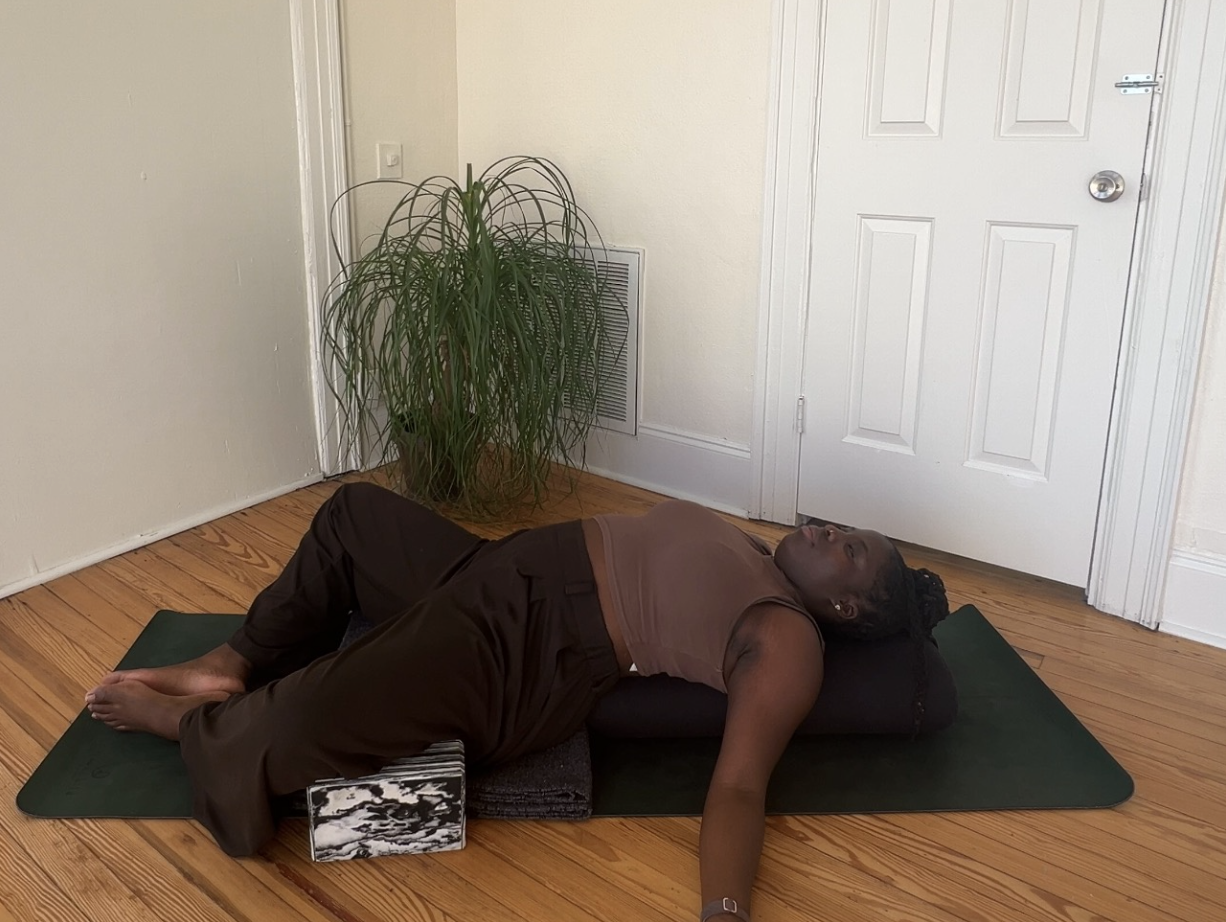
Restorative yoga is a fundamental practice for deep rest. Full stop. It’s built on passive poses that focus on ease and release, held in stillness for several minutes at a time. The practice is rooted in the work of B.K.S. Iyengar, who used props to help students recover from injuries and other health issues. Bolsters, folded blankets, and blocks hold you up so you don’t have to, which means this practice is open to almost anybody, at any age, with any level of mobility or experience. It can even be done in a chair. I think of why it works in three parts.
First, the setup: props support your body so there’s nothing to brace against, and one goal is simply to help your muscles release.
Second, the physiology: once the body feels supported, it activates the parasympathetic nervous system, shifting you out of “fight or flight” and into “rest and digest,” where the heart rate slows and the breath deepens.
Third, the result: restorative yoga slows you down and creates space where rest can happen. And when the body is at rest, it can heal.
Click image to view reel: “rehearsal for resting”
We live in a culture that celebrates staying busy and pushing through. Restorative yoga is an antidote to stress. Rest is not something you have to earn, and it is not wasted time. In this practice, doing less is the point. When you let yourself lie still and be held, you’re not falling behind. You’re coming back to yourself. And every time you practice, you’re doing what I call a rehearsal for resting. That student in Clayton? She’d been rehearsing. That’s why she could walk into the room, reach for her props, and settle in like she’d been doing it all along. With practice, you can too.

This post is for general informational purposes and isn’t medical advice. Please check with your healthcare provider before starting a new practice.